
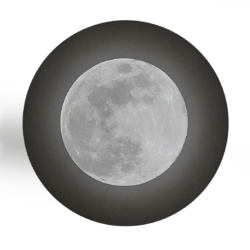
After the cheese story in my previous blog, now here a little harder proof that the moon is made of rock. There is much more insight into the rocks of the moon through the American Apollo space travel to the moon. There are two more space programs that have contributed to more knowledge of moonstone, namely the Russian Loena and that of the Chinese space probe Chang. Goddess of the Moon). What is immediately striking are the differences in the quantity of material that has become available: The Apollo program collected 2415 samples with a combined weight of 382 kg, that of the Loena 326 grams and the last attempt 1.7 grams. Furthermore, there are numerous lunar meteorites smashed into the earth that, if found, have been investigated.
This research means, among other things, that by studying the radioactive atoms in the available lunar rock, also known as radiometric dating, the age of the moon can be mapped. When liquid rock solidifies, as happened in the moon in a distant past, these radioactive atoms are fixed in a crystal grid, a sequencing of atomic bonds in this case. Over time half of the atoms pass to other types of atoms, the half-life. That time is widely known to the researchers. By measuring how many atoms have fallen into a crystal grid they can derive the age of the lunar rock, in this case. It appears that the basalt samples from the lunar seas are 3.2 billion years old to 4.6 billion years for those from the highlands. Here too, there is still a discussion about her exact age.
Of course, the moon rock has also been identified. This is plagiarism and pyroxene and to a lesser extent olive oil and ilmenite. Plagio cheese, which translates from ancient Greek shef to break. The composition contains six important minerals. Forgive me for not going into that now. The colour of plagiaclas is milky white. Pyroxene, also called "fire stranger", contains mainly calcium, sodium and iron and numerous different minerals. Obsidian generally has a dark green to black hue. Olivijn also originates in magma and is also rich in magnesium. It has an olive green color, but can be reddish by oxidation. It was also discovered in meteorites and on Mars. Finally, named after the first site of the rock, the Russian Ilmenbergen in the south of the Urals, varies in color from grey to black and is an iron-titanium oxide mineral.
It turns out that the monsters that the astronauts of the Apollo 11, of which I brought the landing on the moon in the afternoon of July 20, 1969, Dutch time, could follow in a live broadcast in black and white as a boy of eight years old, returned to earth, appear to contain much more water than was originally assumed. Even a hundred times more, which makes the water content match that of rock here on Earth. Converted, when the moon was completely covered with this water, it would produce an ocean of 700 meters deep.

