
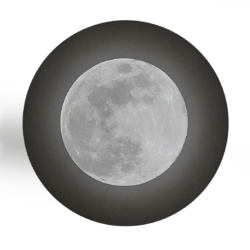
There are several moons in the universe, for example the two moons of Saturn or the many moons of Uranus. Our moon, the fifth in size of all those moons, is almost four times smaller in diameter than the Earth, the planet it orbits.
Earth has 80 times more mass than its only satellite. This satellite orbits the Earth in 29 days, in 29 days, 12 hours, 44 minutes and 2.8 seconds to be more precise. The moon is 384,000 miles from Earth. Because the mass of the earth is so many times greater than that of the moon, the earth has much more influence on the moon than the moon on the earth, unlike the prevailing thought among earthlings who see the moon hanging from the firmament. As a result, the rotation speed of the moon has now been reduced to such a point that it hardly revolves around its axis in relation to that earth.
The origin of the moon is attributed to a collision between the Earth and a planet the size of Mars, called Theia not very long after the origin of the earth. Because of the collision, in which so much heat was released, that the earth and Theia melted and the last went up in the earth, a lump would also have been thrown away. This lump became a big drop, which with its heat attracted other material around her and eventually clots to our moon. This seems to be proven as the rocks of the moon and the crust of the earth are the same.
Although the moon appears to us earthlings as the brightest celestial body, it only reflects sunlight in the direction of the earth. The perfect full moon does not appear to be visible, as the earth, the moon and the sun are exactly aligned, leading to a lunar eclipse.

